
Keystone Pipeline system’s operator agrees to pay a $26.9M penalty over a major Kansas oil spill
TOPEKA, Kan. (AP) — A proposed legal settlement with the U.S. government would require the Keystone Pipeline system’s operator to pay a $26.9 million civil penalty over a major oil spill in Kansas in December 2022 and spend about $40 million more to prevent future accidents.
The agreement would resolve allegations from the U.S. Environmental Protection Agency and Kansas that South Bow, based in Canada, violated U.S. and state clean water laws. The rupture dumped nearly 13,000 barrels of heavy crude oil into a creek running through a rural pasture in Washington County, Kansas, about 150 miles (241 kilometers) northwest of Kansas City.
The accident was the largest onshore crude pipeline spill in the U.S. in nine years and surpassed all 22 previous ones on the same pipeline system combined, according to a 2021 report from the U.S. Government Accountability Office. The total amount of oil spilled would have nearly filled an Olympic-sized swimming pool.
South Bow also would pay Kansas more than $3 million for environmental restoration projects under a proposed decree filed Friday in U.S. District Court in Kansas. A judge would have to approve the proposed decree after a 30-day public comment period.
“The oil spill blanketed land and water, rendering the waterway lifeless and useless and requiring extensive cleanup and remediation,” Jeffrey Hall, the EPA’s assistant administrator for its enforcement office, said in a statement. “The substantial penalty reflects the seriousness of the environmental harm.”
South Bow spokesperson Sara Hunter said in an emailed statement Sunday that the company “proactively” launched its response to the spill before receiving formal directives from government officials, including “comprehensive environmental remediation” completed in February 2024. She also said that since the spill, the company has done more than 12,000 miles (19,312 kilometers) of pipeline inspections and 400 excavations to examine pipe and make repairs where necessary.
“This work reflects our ongoing commitment to the safe, reliable operation of our pipeline system and to continuously strengthening pipeline integrity,” she said.
The company that built the pipeline, TC Energy, spun off South Bow as a separate firm in 2024, after the Kansas cleanup was done.
No pipeline workers or area residents were injured in the spill, and officials said public water supplies weren’t affected. However, a complaint filed Friday by the U.S. government along with the proposed settlement said more than 2,700 animals were harmed or killed. The area is home to an endangered species, the long-eared bat.
In a May 2023 report for the U.S. government, an engineering consulting firm said that a bend in the Keystone system where the spill occurred had been “overstressed” since its installation in December 2010 — likely because construction activity itself altered the land around the pipe. The complaint filed Friday in court said soil under the pipe had been “improperly compacted” and that while the company re-excavated the site in 2013, it did not replace that section of pipe.
The 2,689-mile (4,327-kilometer) Keystone system carries thick, Canadian tar sands oil to refineries in Illinois, Oklahoma and Texas.
In April, President Donald Trump gave the go-ahead for South Bow and another company to build a second pipeline from Canada to Wyoming, a smaller version of a massive $8 billion pipeline project known as Keystone XL blocked by former President Joe Biden’s administration in 2021 over environmental concerns.

Missing man has been found
 UPDATE: The Longview Police Department said Tommy Madewell was found on Monday after he was last seen on July 8.
LONGVIEW – Longview PD is currently searching for Tommy Madewell, a white man, who was last seen leaving the CHRISTUS Good Shepherd Medical Center at around 4 p.m. on July 8. When he was last seen, Madewell was wearing a button down shirt, khaki shorts and a brown pair of shoes.
Anyone with information about his location is asked to contact Longview PD at 903-237-1199.
Community mourns 12-year-old killed in shooting with vigil
NACOGDOCHES (KETK) — A Nacogdoches elementary school hosted a vigil on Sunday to honor the life of a fifth-grade student who was shot and killed over the Fourth of July weekend.
Community mourns 5 victims of Highway 155 crash near Lake Palestine
The vigil for 12-year-old Redarion Davis took place at 6 p.m. on Sunday in the Emeline Carpenter Elementary school parking lot where fellow students, staff, family and friends gathered together to honor his memory.
“It’s not easy to hurt. It won’t go away. The pain won’t stop taking place but it lets the family know that the community, his school and friends are there for them and with them,” Zion Hill Baptist Church pastor Donald Lacey said on Sunday.
Davis sustained a fatal gunshot wound to the head after being involved in a shooting on the fourth of July and later died from related injuries, the Nacogdoches Police Department confirmed.
The Nacogdoches Police Department said 19-year-old Zamarion Douglas has since been arrested and charged with injury to a child in connection to the shooting.
Rep. Moran mourns death of Senator Graham
 TYLER – United States Congressman Nathaniel Moran of Tyler mourned fellow Republican and United States Senator Lindsey Graham of South Carolina, after the senator died on Saturday night. Graham, a four-term United States Senator, was 71 when he died of a “brief and sudden illness” on Saturday evening. Moran said he was saddened by Graham’s death and lauded the senator’s support for the American military around the globe.
“Saddened to learn of the passing of Senator Lindsey Graham. He gave more than two decades of incredible service to the people of South Carolina and to this country,” Moran said on Sunday. “As a staunch defense and foreign policy hawk, he correctly understood the critical role America plays in defense of the cause of freedom. My prayers are with his family, his staff, and all who loved him.”
As Moran noted, Graham was a prominent supporter of the United States’ foreign military aid to countries like Ukraine and Israel. Graham had visited both Ukraine and Israel several times over his four terms in the United States Senate and had just returned from his most recent visit to Ukraine this week when he died. Continue reading Rep. Moran mourns death of Senator Graham
San Augustine Rural Water Supply issues boil water notice for all customers
SAN AUGUSTINE (KETK) – The San Augustine Rural Water Supply issued a boil water notice for all of their customers on Sunday after a water line break happened in the City of San Augustine.
East Texas Rep. Moran mourns death of U.S. Senator Lindsey Graham
Anyone on the San Augustine Rural Water Supply should bring any water for cleaning or consumption to a vigorous rolling boil for at least two minutes before use.
“Children, Seniors and Persons with weakened immune systems are particularly vulnerable to harmful bacteria, and all customers should follow these directions,” the San Augustine Rural Water Supply said. “To ensure destruction of all harmful bacteria and other microbes, water for drinking, cooking and ice making should be boiled and cooled prior to use for drinking water or human consumption purposes.”
The supply said when when the notice is no longer necessary they’ll notify customers that they can go back to normal water use.
Anyone with questions is asked to contact the San Augustine Rural Water System in person at 220 W. Columbia Street in San Augustine or by phone at 936-288-0489.
Eight injured in I-20 crash
 LINDALE – At least 8 people were injured in crashes on Interstate 20 Sunday after an 18-wheeler rolled over, blocking traffic on the roadway. According to the Lindale Fire Department and our news partner KETK, firefighters were working on a first crash on Interstate 20 when they got word about a rollover crash.
The rollover crash happened at around 2:45 p.m. on Sunday in the westbound lanes of Interstate 20, just before the interstate reaches the Highway 69 bridge near mile marker 557 in the southern part of Lindale. Luckily no injuries were reported from either of those two crashes. Several vehicles then piled up nearby, while other vehicles swerved off the roadway to avoid the crash. Smith County Emergency Services District 2 (ESD2) said they’ve responded to several crashes that happened along Interstate 20, after the rollover.
One crash involved a grey Chevrolet Silverado heading eastbound that crashed and rolled over near Interstate 20 mile marker 569, leaving the truck’s driver injured. A driver in a passenger car that was also heading east was injured when the Chevrolet rolled in the median. Both of those drivers were then transported to local hospitals for treatment. Continue reading Eight injured in I-20 crash

Car crashes into Taco Bell
 TYLER – A driver and two Taco Bell workers were hospitalized on Sunday after a car crashed into the Taco Bell on West Gentry Parkway in Tyler. The Tyler Police Department reported that traffic at West Gentry Parkway between MLK Boulevard and Van Highway was being rerouted at around 10:30 a.m. on Sunday because of a major crash.
Officials with Tyler PD told our news partner KETK that a woman was leaving church on Van Highway when she had a medical issue causing her to lose control of the vehicle and cross W Gentry Parkway before crashing into the Taco Bell’s drive-thru window.
The woman was injured in the crash along with two Taco Bell workers, one was burnt by oil and the other was injured by debris from the crash, according to Tyler PD. All three people involved have been transported to a local hospital for treatment.
Tyler PD has since reopened all nearby lanes to normal traffic flow.
In Focus: 07/12/26 and 05/10/26 – Becki Mangum, CEO of Andrews Behavioral Health
Dangerous heat wave threatens oppressive temperatures in much of the US
TEXAS – A widespread and dangerous heat wave was building across the U.S. on Saturday, with triple-digit highs expected in the Southwest and Great Plains this weekend before spreading eastward under a dome of high pressure that meteorologists say could trap oppressive temperatures for a week or more.
Forecasters advised people to stay hydrated and find places to cool off, warning of temperatures 15 to 25 degrees Fahrenheit (8 to 14 degrees Celsius) warmer than normal in many areas, including at night — especially bad for people’s health because their bodies won’t have a chance to recover. The heat dome was expected to affect as much as two-thirds of the continental United States.
“The heat doesn’t necessarily stop when it’s dark out,” said Josh Adam, a meteorologist with the National Weather Service in Bismarck, North Dakota, where temperatures will surpass 100 F (37 C) until Tuesday, a dramatic spike for a state where summer temperatures are typically in the 80s.
Tynika Smith of Bloomington, Minnesota, handed out frozen towels and wash cloths along with battery-operated fans at encampments of homeless people in nearby St. Paul and will continue next week, when temperatures are forecast to climb into the mid- to high 90s. The residents put the ice packs around their necks and on their heads.
“They can’t get into a car with air conditioning or go into a house,” said Smith, who also distributed water, freezer pops, food and hygiene supplies.
The encampments are so secluded that it’s difficult for the residents to walk or bicycle to cooling centers, she said. There also is little outside shade, while the temperature inside their tents gets even hotter than outdoors.
“I can only do so much,” Smith said, “but at least I can help them stay cool for a little bit.”
Temperature records expected to be broken
The National Weather Service predicted that more than 90 U.S. local temperature records will be tied or broken through Wednesday — with two-thirds of those being overnight heat records. Temperatures were not forecast to drop below 80 F (27 C) at night in Fort Lauderdale, Florida; Miami; Tampa, Florida; Galveston, Texas; and Charleston, South Carolina.
The heat dome — formed when high pressure traps hot air while blocking cooling winds and rain — is one of the strongest to affect the Dakotas in 25 years, said Chad Merrill, a senior meteorologist with AccuWeather.
Record triple-digit highs were forecast for the weekend in Nevada, Utah, Colorado, Wyoming, Idaho, Montana and the Dakotas.
In Helena, Montana, where temperatures were expected to creep above 95 F (35 C), Last Chance Splash Waterpark & Pool was holding a swim meet for hundreds of swimmers.
The timing couldn’t be better, as it’s uncommon for Helena to get so hot, said Sean Swingley, assistant manager.
“It’s certainly a hot day, but the pool is nice and cool,” Swingley said. “Usually in the summer we have a couple 95 degree days, but it mostly hovers around 85 to 90 in June and July.”
Nevada, a state accustomed to hot weather, was even hotter than normal, said Andrew Gorelow, a meteorologist with the National Weather Service in Las Vegas. The temperature there was expected to hit 111 F (48 C) on Saturday, Gorelow said.
Hydrating and finding cool spaces is critical, experts said.
They also warned that the heat could spike fire risk in some parts of the country that already are dry, including the Rockies, where Merrill said dry thunderstorms could develop.
Climate change is supercharging heat
Climate change from the burning of coal, oil and natural gas is causing more intense and longer-lasting heat waves that cover larger areas, scientists say.
This year’s temperatures also are expected to be affected by El Nino, a natural warming of the equatorial Pacific that alters weather patterns and spikes temperatures across the globe.
The current El Nino — which formed last month and is too young to have affected this heat wave much — is expected to rank as among the most intense since the weather service began tracking the phenomena in 1950, experts said.
By fall it has an 81% chance of becoming “very strong” — the top category — according to the U.S. National Oceanic and Atmospheric Administration.
___
The Associated Press’ climate and environmental coverage receives financial support from multiple private foundations. AP is solely responsible for all content. Find AP’s standards for working with philanthropies, a list of supporters and funded coverage areas at AP.org.

Company sues water district over wells
 HENDERSON COUNTY — A Dallas-area company, which is attempting to install dozens of high capacity water wells in East Texas, is suing a groundwater conservation district for their “deliberate scheme” to allegedly stop the company from drilling. As the fight for groundwater rights continue in Texas, the owners of Redtown Ranch Holding, LLC and Pine Bliss, LLC filed a lawsuit in federal court on Tuesday against the Neches and Trinity Valleys Groundwater Conservation District. This stems from a years long dispute, as they attempt to obtain permits to drill 43 water wells on their properties in Anderson and Henderson counties.
Since then, the plaintiffs have faced several obstacles after the district suspended their permits and allegedly blocked them from filing new applications under a new moratorium that was adopted in May.
The Background
In 2024, Redtown Ranch Holdings and Pine Bliss sought 43 permits from the state for high-capacity water wells on their properties, which span an approximate total of 11,500 acres across Anderson and Henderson Counties.
Shortly after passing through a few application processes, the NTVGCD voted to suspend all 40 permits after numerous East Texas public officials began to speak out against the proposed wells and their potential impact on the Carrizo-Wilcox Aquifer, which supplies water for the ranches’ groundwater and much of the counties. Continue reading Company sues water district over wells
Four killed in fatal head-on crash on US Highway 259
BOWIE COUNTY (KETK) – Four people were killed in a fatal two-vehicle crash on US Highway 259 on Saturday morning near DeKalb.
According to the Texas Department of Public Safety, a Nissan Altima was heading north along on US Highway 259 about four miles south of DeKalb in Bowie County at around 3:20 a.m. on Saturday.
DPS said the Nissan crossed into oncoming traffic in the southbound lane and collided head-on with a Dodge Charger that was heading south. Four people were pronounced dead at the scene including the three occupants of the Dodge, Joel Ellestad, 22, Payton Butler, 24, Ty Byrd, 20, and the driver of the Nissan, Dru Wilson, 23 of DeKalb.
“The entire Daingerfield-Lone Star ISD community extends its heartfelt condolences to the Butler, Byrd, and Ellestad families during this time of profound loss. Our thoughts and prayers are with each family as you grieve the loss of your loved ones,” Daingerfield-Lone Star ISD said on Friday. “We pray that you find strength in the love of family, the support of friends, and the cherished memories that will forever remain in your hearts. The Blue Tiger Family stands with you, lifting you in prayer and surrounding you with our love, care, and support.”
A DPS investigation into the crash is currently ongoing.

Sheriff’s Office mourns deputy
 SMITH COUNTY – The Smith County Sheriff’s Office gathered together on Saturday to honor fallen deputy Gerald Atchison. The 53-year-old Atchison died unexpectedly on Tuesday after a medical emergency that officials suspect was a heart attack. Atchison was working on duty at the sheriff’s on Tuesday as a property and evidence technician when the medical emergency happened.
Atchison had worked with the sheriff’s office for over 20 years. He started in September of 2003 as a Smith County Jail detention officer. He then graduated from the Tyler Junior College Police Academy in 2005 and was later promoted to the sheriff’s office patrol division.
Saturday’s service, visitation and reception for Atchison were held at the Grace Community Church at 1 p.m. in Tyler.
Polk County Sheriff’s Office seeking further information on suspect recently arrested in connection with a woman’s murder
POLK COUNTY (KETK)– The Polk County Sheriff’s Office is seeking more information regarding a 36-year-old man who was arrested on Friday in connection with a woman’s murder.
According to the sheriff’s office, Cody Allen Laviolette was arrested and charged with aggravated assault and unlawful restraint in connection with a woman’s death in May. Laviolette’s mother was also arrested on Friday and charged with manufacture and delivery of a controlled substance.
Prior to the arrest, several women allegedly came forward to investigators to report their interactions with Laviolette, according to the sheriff’s office.
Additionally, the sheriff’s office said they have individuals who may have information about Laviolette but are believed to be reluctant to come forward due to the notion that Laviolette is protected by his family in Onalaska.
“The Sheriff’s Office is asking anyone who may have witnessed criminal activity involving Cody Laviolette or who believe they may have been a victim to contact investigators. Information provided by witnesses and victims may assist in addressing these matters and advancing the ongoing investigation,” the sheriff’s office said.
Polk County Sheriff’s Office seeking further information on suspect recently arrested in connection with a woman’s murder

Man charged in deputy-involved shooting
 MARION COUNTY — A man was booked into the Marion County Jail on Wednesday due to his alleged involvement in an officer-involved shooting in June. According to the Marion County Sheriff’s Office and our news partner KETK, the shooting occurred on June 24 in the 2700 block of Highway 49. Once deputies arrived on the scene, a man who was later identified as Robert Landrum discharged a rifle, allegedly striking a deputy’s patrol unit.
As additional deputies arrived on the scene, Landrum allegedly refused to disarm and was shot by law enforcement after pointing his gun towards deputies, the sheriff’s office said. Landrum was then taken into custody and flown to a hospital in Shreveport. After being released from the hospital, Landrum was booked into the Marion County Jail on Thursday and charged with aggravated assault against a public servant.
The Texas Rangers have launched an investigation and the sheriff’s office said no additional information will be released at this time.
Appeals court rejects effort to defend Texas law offering in-state tuition for undocumented students
A federal appeals court on Thursday rejected an effort to defend the Texas Dream Act, leaving in place a ruling that ended a longstanding state law that allowed some undocumented students to pay in-state tuition at public colleges and universities.
The 5th U.S. Circuit Court of Appeals said advocacy groups, Austin Community College and a student could not step into the case to defend the Texas Dream Act because federal law bars states from giving undocumented students a tuition benefit based on residency unless the same benefit is available to all U.S. citizens, regardless of where they live.
The law allowed students who graduated from a Texas high school or earned an equivalent diploma in the state, lived in Texas and pledged to seek permanent residency when eligible to pay in-state tuition, even if they did not have legal immigration status.
Gov. Greg Abbott praised the 2-1 ruling on X, saying Texas and the Trump administration’s Justice Department “just secured another major victory for the rule of law.”
La Unión del Pueblo Entero and the Mexican American Legal Defense and Educational Fund called the ruling a disappointment.
“Education is a human right, no matter someone’s immigration status or background,” said Tania Chavez Camacho, LUPE’s president and executive director.
Thomas A. Saenz, president and general counsel of MALDEF, which represents Students for Affordable Tuition, said the organization would seek further review in federal court after consulting with its clients.
Saenz said the panel majority was “now complicit in one of the greatest juridical travesties in recent history,” referring to the swift end of the Texas Dream Act after Attorney General Ken Paxton’s office and the Trump administration agreed the law should be blocked.
Austin Community College said in a statement that it “remains focused on supporting all students and the community we serve” and would follow the law while continuing its mission to provide “accessible, high-quality education and opportunities for all.”
Marco Julian Gonzalez, a University of Texas at Austin business student whose fraternity and sister sorority backed the students in court, said the ruling was disheartening.
“We know who these people are and we know who they are not, and when you have politicians go on the airwaves and call our friends criminal illegal aliens we take offense and that kept us motivated to keep going,” Gonzalez said.
Judge Jerry E. Smith wrote the majority opinion for the 5th Circuit Court, joined by Judge Don Willett. Judge Irma Carrillo Ramirez dissented.
Smith was appointed by President Ronald Reagan, Willett by President Donald Trump, and Ramirez by President Joe Biden.
The background
Texas was the first state to let certain undocumented students pay in-state tuition when lawmakers passed the Texas Dream Act in 2001 with little debate and broad, bipartisan support.
The law, signed by the Republican former Gov. Rick Perry, allowed certain students without legal status to qualify if they graduated from a Texas high school or earned an equivalent diploma here, lived in the state for at least three years before graduating and signed an affidavit saying they would seek permanent residency as soon as they were eligible.
Supporters said Texas benefited from students educated in its K-12 schools by making college more affordable and moving them into the workforce. But as Republican politics shifted on immigration, the law became a target.
After multiple failed efforts from state lawmakers to change the law, U.S. Justice Department lawyers sued Texas last year. Paxton’s office quickly agreed the law conflicted with federal immigration law and asked a judge to block it. U.S. District Judge Reed O’Connor approved the agreement and blocked the law the same day.
Students for Affordable Tuition, La Unión del Pueblo Entero, Austin Community College and student Oscar Silva asked the court to let them defend the Texas Dream Act themselves.
Students for Affordable Tuition is a group of students who say they were harmed by the ruling. La Unión del Pueblo Entero, or LUPE, is an immigrant-rights group. They asked to intervene along with Austin Community College and Silva, a University of North Texas graduate student who qualified for in-state tuition under the Texas Dream Act.
O’Connor, a President George W. Bush appointee who sits in the Northern District of Texas’ Wichita Falls division, rejected their request, so they appealed to the 5th Circuit.
What the students and immigrant advocates say
Advocacy groups Students for Affordable Tuition and LUPE, Austin Community College and Silva argued they have the legal right to intervene. They urged the court to apply a more lenient standard for intervention instead of requiring proof that their defense of the Texas Dream Act would ultimately succeed.
Students for Affordable Tuition said the stakes are concrete for its members, who “face significant increases in their higher education costs, putting college out of reach for many of them, some of whom have already spent years in college and will not be able to complete their specific program.”
“The people of Texas are entitled to genuine litigation before a federal court invalidates their democratically enacted statute,” lawyers said in a legal brief to the 5th Circuit.
Thomas Saenz, the lead lawyer for Students for Affordable Tuition, also stressed that affected students did not get due process because of how quickly the Texas Dream Act was overturned.
It is “important to emphasize here how extraordinary that it all occurred as quickly as it did,” Saenz told the 5th Circuit during oral arguments on June 4. “The court needs to look at whether this extraordinary situation violated due process rights held by students for affordable tuition and the other students who benefited or would benefit in the future.”
The groups believed the Texas Dream Act did not conflict with federal law because eligibility was not based solely on residency. Students also had to graduate from a Texas high school or earn an equivalent diploma here, live in the state for at least three years before graduating and sign an affidavit saying they would seek permanent residency as soon as they were eligible.
What the federal government says
Justice Department lawyers sued Texas, saying the Texas Dream Act violated a 1996 federal immigration law. That federal law says states cannot give people who are not lawfully present a higher education benefit unless U.S. citizens can get the same benefit, no matter where they live.
U.S. Department of Justice attorneys arguedvthat the Texas Dream Act so clearly conflicted with federal immigration law that allowing others to intervene and defend it would be futile.
“We opposed intervention … only on the grounds that it’s legally futile because the statutes are preempted,” Andrew Marshall Bernie, an attorney with the U.S. Department of Justice, told the appeals court during oral arguments last month.
Responding to concerns over due process, Bernie argued courts are not constitutionally required to hear from outside groups when a state law is challenged for violating a federal statute. In the end, he said, the outside groups did get due process because their arguments have been heard by the trial court and the 5th Circuit.
Broader impact
The Texas Dream Act opened higher education to more than 57,000 students, lawyers for LUPE, ACC and Silva told the court. The end of the law could cost Texas hundreds of millions of dollars a year through reduced wages, earnings and consumer spending, lawyers for LUPE, ACC and Silva told the court. ACC said it expected lost revenue, administrative burdens and negative effects on programs and services if the ruling remains in place.
Since O’Connor blocked the Texas Dream Act last year, students and colleges across the state have faced confusion over who still qualifies for in-state tuition.
The Texas Higher Education Coordinating Board told colleges to identify and reclassify students who are not lawfully present as nonresidents but did not provide clarity on how to do so. That uncertainty led at least one student with Deferred Action for Childhood Arrivals, or DACA, to be initially charged out-of-state tuition, The Texas Tribune previously reported.
Students for Affordable Tuition told the 5th Circuit that several Texas colleges had charged DACA recipients out-of-state rates, even though Texas lawyers said they should still qualify for in-state tuition.
___
This story was originally published by The Texas Tribune and distributed through a partnership with The Associated Press.
Detainees tell their lawyer an ICE officer shot a Houston driver through a passenger window
HOUSTON (AP) — Three men inside a van who witnessed the fatal shooting of the driver by an immigration officer in Houston said the Mexican man was shot through a passenger window and that the officer was never threatened, a lawyer who has spoken with them said Friday.
The shooting Tuesday during an attempted traffic stop by Immigration and Customs Enforcement officers in Houston has revived critical voices deriding the Trump administration’s immigration crackdown and how ICE operates. Immigration arrests around the country recently surged to 10,000 over a five-day period, fueled in part by massive Congressional funding.
The Department of Homeland Security, which oversees ICE, has released no evidence to support the officer’s story that Lorenzo Salgado Araujo ignored their commands and rammed into an ICE vehicle with his white van, or that the officer fired in self-defense.
Democratic U.S. Rep. Sylvia Garcia has said the acting director of ICE told her officers thought someone in the van, but not Salgado Araujo, had a final order of removal but did not share a name.
The officers were not wearing body cameras and neither ICE nor DHS have released photos, videos or other evidence from the scene.
The men tell an attorney that the ICE story is untrue
Salgado Araujo was a 52-year-old homebuilder who was shot and killed as he was driving his crew to a construction site. His family said he had lived in the U.S. for more than 35 years, had no criminal record and was close to finishing the long process of obtaining legal status when he was killed.
ICE detained the other three men in the van and they all told a lawyer that no officer was in front of the van or even in danger.
“After speaking with these men, I have no doubt that what they’re saying is the truth. I know that these agents — the agency — is going to try to cover it up,” attorney Hugo Balderas-Ibarra said during a news conference.
Images of the van after the shooting appear to show no damage, he said.
ICE has not released the names of the detained men, but family members said they have been able to briefly talk with them. Salgado Araujo’s brother was among those arrested.
Garcia said at the same news conference it was unsurprising that Salgado Araujo drove off when ICE tried to stop his vehicle, given that their vehicles were unmarked and had no lights.
“What would you do if you were being followed by someone and the cars were unmarked?” Garcia said.
Salgado Araujo was at least the eighth person to die during the Trump administration’s immigration enforcement campaign. No immigration officers have been charged in the killings and video footage in several previous shootings has contradicted the accounts of federal officers.
The detained men say ICE is pressuring them to self-deport
ICE is pressuring the men to self-deport, which would make it harder for them to share their version of events with investigators or others, said Juana Degollado, who said her stepfather Daniel Tirado Pantoja is among the detained men. She said he has no legal permission to live in the U.S. but has no criminal record.
“It is extremely important that we preserve the integrity of this investigation,” Balderas-Ibarra said. “That will all be out the window if they are deported.”
DHS said allegations that the men have been pressured to leave the country are “categorically false.”
DHS said Thursday that officers investigating a tip weeks earlier saw two white vans at the address of a target. While heading to that address Tuesday, officers saw a white van and someone inside who resembled the person they were looking for, the department said in a statement.
“No one in that van had warrants or any legal problem,” Degollado told The Associated Press in a text message.
ICE refuses to release officer’s name or other information
DHS said it will not release the officer’s name because they could face threats and violence and their family could be at risk.
DHS also has not responded to requests for other information, including how long the officer has worked for ICE or whether anyone involved in the shooting is on administrative leave.
Unlike some previous deaths involving federal immigration officers, few photos or videos surrounding the shooting have emerged publicly in the days since Salgado Araujo’s death.
The League of United Latin American Citizens offered a $5,000 reward for video or other evidence, but the positions of the vehicles means surveillance cameras in the area were blocked from recording the shooting, CEO Juan Proaño said.
Local prosecutors are talking to witnesses
Local prosecutors were not invited into the investigation by federal officials but have spent the past three days in the Houston neighborhood looking for surveillance footage and talking to witnesses, Harris County District Attorney Sean Teare said.
Teare said anyone with video or other information must share it with his office so the truth about the shooting can be determined.
“We will go to the ends of the earth to collect all the evidence, so that we can eventually let the public know what happened,” Teare said.
The FBI is tightly controlling the evidence in the case, but Houston Mayor John Whitmire said he wants a local independent investigation and the police chief will meet with federal investigators next week to see what can be done.
“We recognize that it is a federal police agency that was out of control Tuesday morning,” Whitmire said.
Houston police do not work with ICE and the mayor said he found out about the shooting from the media.
Salgado Araujo’s family said they found out he was dead through the ICE statement instead of directly from the agency. Garcia said officers kept his belongings and sent him to the hospital where he died without including his name.
___
Brook reported from New Orleans and Foley from Iowa City, Iowa. Associated Press reporters Valerie Gonzalez in McAllen, Texas; Rebecca Santana in Washington; and Jeffrey Collins in Columbia, South Carolina, contributed.
Both engines flamed out before small jet crashed in June on Texas highway, NTSB report says
Both engines flamed out on a small business jet that crashed on a Texas highway in June, preventing the pilots from being able to reach a nearby airport, the National Transportation Safety Board said in an preliminary investigation report released Friday.
Pilots had looked for a field or other flat areas to land before the crash, but were told by air traffic controllers that there were none close by. The crash killed one person and injured six.
According to the report, the flight crew noticed an “unusual vibration” early in the flight that they had not experienced before. The plane had departed the Mexican resort city of San José del Cabo on its way to Austin, and it was determined that they could proceed to their final destination after discussing it with staff at NetJets, the company that operated the jet.
As the jet approached the U.S.-Mexico border, the flight crew received a message indicating that the right fuel system had low fuel pressure, followed by more messages, and the crew declared an emergency.
The flight crew reported a generator failure and “multiple other failures” to Houston air traffic controllers, such as “fuel level low,” and requested to divert to Laredo International Airport, according to the report. The jet was cleared but while it was on its final approach, the right engine “flamed out,” followed by the left engine moments later.
Video footage showed “two instances of fire flaring up around the airplane as it was on final approach,” the report states.
A pilot asked the Laredo air traffic control tower if there was a field to their right, and an air traffic controller replied that there was not. After the pilot again asked about open area to their right, an air traffic controller replied, “It’s just going to be the main highway, and that’s just about it.”
The flight crew “maneuvered the airplane to touch down” on the highway about 1 mile (1.6 kilometers) southeast of the airport. As the jet touched down, it “sheared off several light poles,” struck a vehicle and ended up straddling the edge of an overpass with the main cabin exit door facing up. The door was eventually opened and five people escaped.
The NTSB report also asserts that the jet’s right engine starter generator was “missing multiple screws from the outer housing.” Alan Diehl, a former NTSB investigator, said the jet’s problems likely stemmed from the missing screws and that the flight crew and air traffic controllers acted professionally with the information they had at the time.
“Sounds like the fuel lines, because of the vibration caused by the starter generator’s missing screws, initiated a whole series of cascading events that led to the emergency loss of power,” Diehl said.
Jeff Guzzetti, a former Federal Aviation Administration and NTSB investigator, said signs point to an “airworthiness issue.”
“That might tie back to maintenance procedures from when that unit was overhauled or when the fuel system and fuel sensors were tested,” Guzzetti said.
The fiery crash in Laredo near the Mexican border had sent bystanders racing from their cars to help police rescue passengers and crew from the burning aircraft. Video from the scene showed someone trying to smash the cockpit glass with a sledgehammer, while others used makeshift levers as they worked to open the plane’s door. Local officials said a firefighter entered the smoke-filled jet to extract one person still inside after the rest had escaped.
The jet “sustained substantial damage” to its fuselage, both wings, and the tail, according to the NTSB report.
Two pilots and three teenagers survived the crash and were released from the hospital, according to the Laredo Police Department. A dog on board suffered smoke inhalation but was expected to survive, Jose Baeza, an investigator with the police department, said in June.
The crash killed Joshua Baer, a leader in Texas’ technology and startup sectors.
___
This story has been updated to correct the name of the company that operated the jet. It is NetJets, not NetsJet.
DHS was granted $20M for body cameras. ICE agents in fatal Houston shooting had none
WASHINGTON (AP) — Crews are again draining the Lincoln Memorial Reflecting Pool as President Donald Trump’s problem-plagued efforts to revamp the waterway pushes well past his initial goal of having it ready by July 4 to mark the nation’s 250th birthday.
The president at first suggested his renovations would last a century. But, within weeks of the project originally reaching completion last month, the water was beset by an algae bloom and pieces of the new coating appeared to be peeling off the bottom.
Trump has blamed the peeling on vandals, though critics allege it’s from shoddy repair work.
Interior Secretary Doug Burgum, whose agency oversees the National Park Service, told conservative podcaster Katie Miller in an interview released earlier this week that the new round of draining was planned. He also said that the water might still contain debris from an extensive Independence Day fireworks display over the National Mall.
“Drain the water, clean up the fireworks stuff,” Burgum told Miller, who is the wife of deputy White House chief of staff Stephen Miller. “Repair the vandalism that was done. Fill it back up again.”
The work on the Reflecting Pool is just one of a number of projects Trump has spearheaded across the nation’s capital. Most prominently, he demolished the White House’s East Wing to build a $400 million ballroom and plans to build a towering arch between the Lincoln Memorial and Arlington National Cemetery.
He initially announced his intentions to beautify the Reflecting Pool this spring, saying he wanted it completed before the nation’s 250th birthday celebrations.
Water was drained and Trump directed that the bottom be painted what he called “American flag blue.” In May, the president posted on his social media site of the pool: “The goal is to have it done, at this higher level, prior to July 4th — We are ahead of schedule!”
But problems began quickly after the initial work was finished. Trump blamed vandals, and court documents later showed that the National Park Service reported to the U.S. Park Police a June 9 incident in which a sharp knife or razor cut the pool’s new liner.
On Thursday, former Olympic canoe racer David Hearn pleaded not guilty in D.C. Superior Court to deliberately damaging the Reflecting Pool. Hearn has said he reached inside the pool to examine the peeled sealant and let go of a chunk when he was told to by a park worker.
His attorneys and other Trump administration critics have derided the case as an abuse of prosecutorial power and maintain he is being scapegoated for the poor job done fixing up the Reflecting Pool.
At least three other people have been charged in the same court with misdemeanors for allegedly removing pieces of paint from the Reflecting Pool, according to online court records. All three pleaded not guilty during their initial court appearances Wednesday.
The pool was closed for the Independence Day celebration, which featured what Trump said was the largest fireworks display in the world. The president had said that the pool would have to be drained anew as part of the new round of repairs.
Burgum has also said that the Trump administration won’t seek bids for the new rounds of repairs. He told CNN’s “State of the Union” last weekend: “We’ll use the same company because they did a fantastic job.”
Ohio-based Green Water Solutions, also known as Greenwater Services, was given a $1.7 million contract to install a water-purification system in the Reflecting Pool, while Virginia-based Atlantic Industrial Coatings was awarded $14.7 million to repaint and waterproof the pool’s concrete floor.
Democratic senators and House members are investigating the pool project, including seeking answers about how much taxpayer funding is involved.

Friday traffic detours
 TYLER – Tyler Police Department is reporting that power lines are down in the roadway on Palace Avenue between West Elm Street and West Erwin Street. All southbound lanes on Palace between Elm and Erwin are closed. Northbound lanes are still open. Utility companies are enroute for repairs, but it is unknown how long the repairs will take. Take alternate routes and avoid this area. There are officers on the road directing traffic.

Community mourns victims of crash
 PALESTINE – The Texas Department of Public Safety has released new information about the five people who died after Thursday’s head on crash on Highway 155, near Lake Palestine. According to DPS, the driver of a white Cadillac SUV who was killed in the crash has been identified as Rhanda Lacy, 60 of Crockett. The adult passengers who died were identified as Leshonda Shepherd, 41, of Crockett and Cynthia Donnell, 63, of Palestine. A four-year-old child who was also onboard later died at a Dallas hospital.
The driver of a Toyota Highlander who died in the crash has been identified as Jonathan Ryal, 51, of Tyler. According to new information from DPS, Ryal drove across the center lane crashing into the Cadillac, leaving him with fatal injuries.
Palestine ISD said the loss of Coach Ryal has rattled the student body, he was an alumni who had coached cross country and varsity soccer for close to 15 years. Continue reading Community mourns victims of crash

Grocery chain to expand
 TYLER – Brookshire’s Grocery Co. (BGC) hosted a groundbreaking ceremony on Thursday to celebrate the opening of its new location in West Tyler, set to open in 2027, with a popular local restaurant joining in the festivities.The new West Tyler location will allow BGC to meet the growing needs of customers with high-quality fresh meats, produce, amenities such as Starbucks Coffee and a full-service pizza kitchen, according to BGC.
“This groundbreaking represents a significant milestone for BGC — one that I know our founders, W.T. and Louis Brookshire, would be incredibly proud of,” Jerry LeClair, interim CEO for Brookshire Grocery Co., said.
The store will also feature the classic Brookshires hometown feel East Texans love, with a modern twist from another iconic Piney Woods name. A full-service Stanley’s Barbeque restaurant and bar will be added to the BGC store family.
“Both BGC and Stanley’s have deep roots in Tyler,” LeClair said. “Together we’ll create an experience that is uniquely East Texas and uniquely Tyler. We’re Proud to partner with a local business that has become a true East Texas institution and give our customers another reason to gather, connect and enjoy a great meal together.”
In addition to providing a new place for East Texans to shop, the store will create over 200 new job opportunities in Tyler.
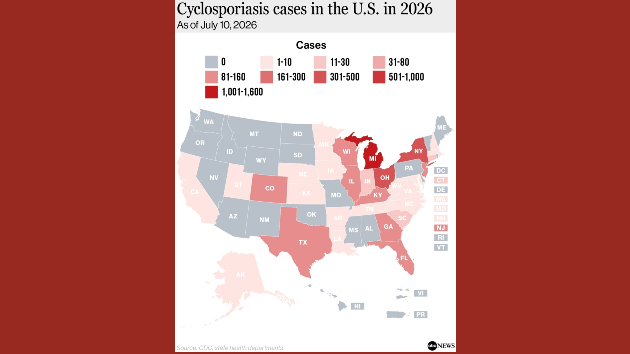
Here’s where cyclosporiasis is spreading as cases are confirmed in 32 states

(NEW YORK) -- Cases of cyclosporiasis, an intestinal infection caused by a parasite, are currently being reported in nearly three dozen states, according to an ABC News tally.
As of Friday, at least 2,844 cases have been reported in 32 states, data from the Centers for Disease Control and Prevention (CDC) and state health departments show.
The CDC said the true number of people sick with cyclosporiasis is likely higher than the reported figure because some people recover without medical care and are not tested for the parasite.
Most cases are currently being reported in Michigan with 1,562 as of Friday, according to the Michigan Department of Health and Human Services (MDHHS). At least 44 people have been hospitalized in the state.
This is 31 times higher than the approximately 50 cases that Michigan sees every year, according to the health department.
Michigan health officials previously told ABC News that the working hypothesis is the outbreak is linked to food contamination but, so far, no produce, grower or supplier has been identified.
The parasite usually spreads through food or water contaminated with feces, according to the CDC.
Foodborne outbreaks of cyclosporiasis have been linked to various types of imported fresh produce, such as raspberries, basil, snow peas, mesclun lettuce and cilantro, the CDC says.
New York is reporting the second highest number of cases at 394, followed by Ohio at 364, according to data from both state health departments. Meanwhile, Illinois and Florida are each reporting more than 100 cases, according to their respective health departments.
The most common symptom of cyclosporiasis is watery diarrhea "with frequent and sometimes explosive bowel movements," according to the CDC. Other symptoms nay include nausea, vomiting, abdominal pain or bloating.
The time between becoming infected and showing symptoms is typically about one week but can range from two days to two weeks, the CDC says. The lag can make it difficult to trace back what may have infected someone, doctors previously told ABC News.
Cyclosporiasis is treated with the oral antibiotic trimethoprim-sulfamethoxazole (TMP-SMX), commonly sold as Bactrim, Septra and Cotrim, and taken for 10 days, according to the CDC.
The agency says people can prevent infection by thoroughly washing produce, cutting away bruised or damaged parts of fruits and vegetables and refrigerating pre-prepared or pre-cut produce.
Additionally, the CDC recommends washing hands thoroughly with soap and water before handling or preparing raw fruits and vegetables.
Copyright © 2026, ABC Audio. All rights reserved.

Stocks and oil prices drift, while South Korean AI darling SK Hynix leaps in its Wall Street debut
 NEW YORK (AP) — U.S. stocks and oil prices are drifting toward a quiet finish of the week Friday following their earlier fireworks on worries about how the war with Iran will affect the global flow of crude.
The S&P 500 was virtually unchanged in midday trading and on track to close out its fourth winning week in the last five. The Dow Jones Industrial Average was up 101 points, or 0.2%, as of 11:45 a.m. Eastern time, and the Nasdaq composite was 0.2% lower.
Oil prices eased following earlier fluctuations as a series of unclaimed airstrikes hit Iran after the United States said it finished its attacks. The price for a barrel of Brent crude oil, the international standard, fell 0.9% to $75.63.
That’s above its $72 price from the start of the week, but it’s still well below its wartime peak of nearly $120. The worry is that continued fighting could block oil tankers from the Strait of Hormuz and prevent the delivery of crude from the Persian Gulf to customers worldwide.
President Donald Trump said on his social-media platform that he agreed to continue talks with Iran but also that the United States told it “in no uncertain terms, that the Cease Fire is OVER!”
With the wait ongoing for what will happen next with the strait, some of the strongest action on Wall Street was for the U.S. trading debut of a South Korean tech giant, SK Hynix.
The chip company raised roughly $26.5 billion by selling American depositary shares at a price of $149 each. That price jumped immediately after the ADRs began to trade on the Nasdaq in the midday hours, and it was most recently up 13.4%.
SK Hynix’s stock in Seoul has already surged 634% over the last year thanks to euphoria around artificial-intelligence technology. The boom has created real profits thanks to surging demand for computer memory. But it’s also raised worries that AI stock prices have shot too high and that all the world’s spending on chips and data centers won’t be able to produce enough productivity and profit growth to make it worth it.
Beyond the sharp recent swings for AI stocks, the focus on Wall Street is shifting to the upcoming reporting season for companies’ profits during the spring.
Delta Air Lines said it was able to absorb higher fuel prices from April through June because of strong demand from customers to fly, including a wide range of corporate travelers. Its profit and revenue topped analysts’ expectations, and it gave a forecasted range for profit in the summer whose midpoint was above analysts’ expectations.
ss
Delta’s stock fell 2.2%, though, after coming into the day with a strong 28.2% rise for the year so far.
Companies across industries will need to produce big growth in profits to justify the big moves for their stock prices, which are broadly near records. Next week will feature earnings reports from many of the biggest U.S. banks, including Bank of America, Citigroup, JPMorgan Chase, Goldman Sachs and Wells Fargo on Tuesday alone.
Eleswhere on Wall Street, Circle Internet Group rose 5.9%. The company behind the USDC cryptocurrency, which is supposed to keep the value of $1, said it won U.S. regulatory approval to establish a bank. It will operate under the name Circle National Trust, and CEO Jeremy Allaire said the move “marks a defining step in bringing blockchain technology and digital assets into the core of the U.S. financial system.”
WD-40’s stock jumped 10.7% after reporting much stronger profit for the latest quarter than analysts expected.
In the bond market, Treasury yields held relatively steady as oil prices drifted. The yield on the 10-year Treasury remained at 4.55%, where it was late Thursday.
High yields have shaken financial markets worldwide recently. They’ve climbed on worries about expensive oil and high inflation, which could push the Federal Reserve and other central banks to raise interest rates.
Higher rates can keep a lid on inflation, but they also slow the economy and hurt prices for all kinds of investments.
In stock markets abroad, indexes were mixed. South Korea’s Kospi jumped 2.5%, and Japan’s Nikkei 225 rose 1.2% for two of the world’s bigger moves. Stocks fell 1% in Shanghai.
Fatal shooting during Houston traffic stop renews public scrutiny of ICE
HOUSTON (AP) — Federal officials are refusing to release the name of the Immigration and Customs Enforcement officer who fatally shot a Mexican man during a traffic stop in Houston, and scrutiny of the shooting is growing after authorities said the man killed was not the person ICE was trying to find.
The shooting in Houston has revived critical voices deriding the Trump administration’s immigration crackdown and how ICE operates, especially after immigration arrests around the country surged to 10,000 over a recent five-day period, fueled in part by massive Congressional funding.
No evidence has emerged to support the Department of Homeland Security’s version of events that led to the killing early Tuesday of Lorenzo Salgado Araujo — that he rammed an ICE vehicle when it was chasing his white van and that an officer opened fire in self-defense.
Three other men inside the van told an attorney that officers are lying about what happened and that Salgado Araujo did not ram an ICE vehicle but that he was shot through the passenger side window.
The officers were not wearing body cameras and neither ICE nor DHS, which oversees that agency, have released photos, videos or other evidence from the scene.
Salgado Araujo, a 52-year-old homebuilder who was shot and killed as he drove his crew to a construction site, was not who ICE was looking for, Democratic U.S. Rep. Sylvia Garcia said. Salgado Araujo’s family said he had lived in the U.S. for more than 35 years, had no criminal record and was close to finishing the long process of obtaining legal status when he was killed.
ICE detained the other three men in the van and a lawyer who said he has spoken to them said the version told by DHS is “completely false.”
“At no point did they ever use the van to ram into the ICE agents and at no point were these ICE agents lives ever in danger,” attorney Hugo Balderas-Ibarra said on Instagram.
The other men detained by ICE included Salgado Araujo’s brother. ICE has not released their names, but family members said they have been able to briefly talk with them.
ICE is pressuring the men to self-deport which would make it harder for them to share their version of events with investigators or others, and Daniel Tirado Pantoja has no legal permission to live in the U.S. but has no criminal record, his stepdaughter said.
“We just told him not to sign anything, that we’re going to fight this case,” Juana Degollado told The Associated Press.
DHS said these allegations are “categorically false.”
When asked if officers were specifically targeting Salgado Araujo, DHS said Thursday that officers investigating a tip weeks before the shooting saw two white vans at the address of a target. While heading to that address Tuesday, officers saw a white van and someone inside who resembled the person they were looking for, the department said in a statement.
DHS said it will not release the officer’s name because they could face threats and violence and their family could be at risk.
DHS also has not responded to requests for other information, including how long the officer has worked for ICE or whether anyone involved in the shooting is administrative leave. The department has taken a similar stance after previous fatal shootings involving its officers, unlike many local and state agencies that routinely identify and provide biographical details about officers involved in critical incidents.
Unlike some previous deaths involving federal immigration officers, few photos or videos surrounding the shooting have emerged publicly in the days since Salgado Araujo’s death.
The League of United Latin American Citizens offered a $5,000 reward for video or other evidence but the positions of the vehicles means surveillance cameras in the area were blocked from recording the shooting, Proaño said.
_

SWEPCO warns of delays during project
 HALLSVILLE – As two generators and one turbine are delivered to the project site, SWEPCO is getting ready for another significant construction milestone at the future Hallsville Natural Gas Plant. Before starting the last portion of its journey to Hallsville, the equipment will be moved to specialized transport trailers at a rail unloading location in Tenaha after arriving in East Texas by rail. The deliveries complement recent developments at the site, such as the completion of a significant concrete pour for the turbine foundation and ongoing work on the utilities, electrical infrastructure, and foundations supporting future generation operations. Continue reading SWEPCO warns of delays during project

David Rancken’s App of the Day 07/10/26 – Rhyme!
Here is an AI vacation planner that is easy to use. Find David Rancken’s App Of The Day. It’s called Rhyme. You can find Rhyme in the Apple Store.


Fundraiser for lieutenant with cancer
 TYLER – The Tyler Junior College Police Department is hosting a fundraiser this Friday to raise money for one of their lieutenants who was recently diagnosed with cancer.
The fundraiser will be held from 11 a.m. to 2 p.m. in Downtown Tyler. During the fundraiser, lunch plates, which will include a BBQ sandwich, chips, dessert and a drink, will be sold for $10 a plate.
All the money raised from the fundraiser will go toward Lieutenant Brian Lintner, who was recently diagnosed with stage 4 cancer.
“This is an opportunity for our community to come together and support him and his family during this difficult time,” the department said. “We hope you will stop by, enjoy lunch, and help support the Lintner family. Your generosity and support are greatly appreciated.”

Sidewalk robots complete work
 TYLER – This week, the city finished collecting data to enhance accessibility for individuals with disabilities by packing up its DaxBots and conducting a sidewalk survey throughout the city. Officials claim that DaxBots gathered real-time data on 90 miles of pedestrian pathways, including sidewalks and crosswalks at intersections, during the previous four to five weeks. The information will be utilized to evaluate Tyler’s walkways’ present level of accessibility for people with disabilities. Continue reading Sidewalk robots complete work