Today is
Saturday July 18, 2026




FILE – Betty Ford waves goodbye to her husband, President Gerald Ford, as he leaves their Alexandria, Va., home, Aug. 13, 1974, on his way to the White House. (AP Photo/Bob Daugherty, File)
Shortly after assuming office following the resignation of President Richard Nixon in August 1974, President Gerald Ford addressed a Joint Session of Congress. His goal was to move the country past the Watergate scandal. Contained within that speech was this passage:
Whether we like it or not, the American wage earner and the American housewife are a lot better economists than most economists care to admit. They know that a government big enough to give you everything you want is a government big enough to take from you everything you have.”
Those 50 words perfectly set up the examination of the divide between the Democratic Socialists who are quickly taking over the once semi-sane Democratic Party, and the rest of us who know better.
What we who know better understand is that freedom isn’t merely the absence of chains. It’s the ability to make choices, accept consequences, try, fail, and try again; all toward the goal of building a life through personal responsibility. I am fond of saying that personal responsibility is the ultimate expression of freedom.
That freedom so expressed is what built the most successful society in history. An appreciation of that belief, together with the resulting desire to protect those freedoms, is why conservatives (and to be fair for much of our history all but the craziest liberals) know now and knew then that grand promises of free health care, subsidized housing, free college tuition, free child care, guaranteed universal income and the rest of the socialist smorgasbord cannot withstand objective scrutiny. The reason is amazingly simple.
Nothing is free.
It’s worth looking closely at those who are on the vanguard of the Democratic Socialist movement. All of them have in common that they were either born here or have lived here long enough as to make it possible to take the abundance afforded by the American free market economy for granted. In their cossetted existences, plenty to eat, a safe place to sleep and an iPhone in the hand are just things that naturally occur. They never ask who had to put capital at risk and who had to do the work necessary to provide such things.
America has been so successful and enjoys such enormous economic wealth that minds-full-of-mush socialists look at it all and decide that there’s plenty to go around. No need for anyone to unduly exert oneself. Everyone should be free of the daily burdens of making a living so that everyone can enjoy economic freedom in its ultimate form.
What they don’t understand is that every promised benefit supplied by government must first be confiscated from the fruits of someone’s labor. The larger those promises become, the larger the confiscatory power of government must become – until one day that power becomes absolute.
When that happens, you get the blood-soaked regimes of Stalin, Mao, Castro and Maduro.
The ascendant socialists in the Democratic Party are promising what they believe will be economic freedom. If they ever succeed in gaining power, they will deliver precisely the opposite.
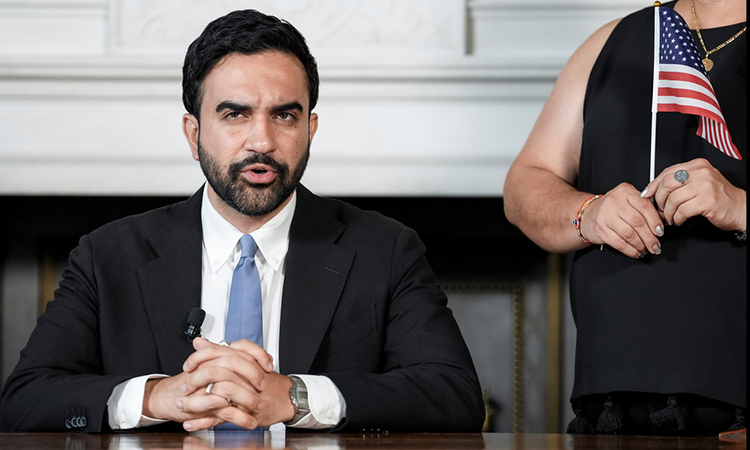
New York City Democratic Socialist Mayor Zohran Mamdani (Anna Connors/The New York Times via AP, Pool)
Government accountants recently reported that Social Security is in real fiscal trouble. The system is paying out about $230 billion per year more than it’s taking in from payroll taxes.
Those shortfalls are being covered for now by redeeming the U.S. Treasury bonds that Social Security was required by law to purchase back when it was running a cash surplus. (Fun fact, for decades those bonds were kept in an ordinary locked filing cabinet in a government office in Parkersburg, WV. Today, the records are all electronic.)
When Social Security needs cash to cover payouts to recipients, it presents one of those bonds to the U.S. Treasury Department for redemption. The funds are deposited in Social Security’s operating account, and everyone gets their monthly benefit.
But here’s the rub. At the rate of $230 billion a year in redemptions, those bonds will all be cashed in by 2033. After that, Social Security won’t have enough cash to cover its monthly payouts. If that were to happen today, it would mean an automatic 22 percent reduction in benefits to every Social Security recipient in the country. Things would get politically ugly really quick.
I bring this up not for purposes of doing a column on Social Security but rather to ask a pointed question of the Democratic Socialist mayors and congressional candidates that have lately been in the news.
Ladies and gentlemen, Social Security has been around for about 90 years. It’s not new. So, if there’s not enough money from taxation to cover a long-established program like Social Security, from where do you imagine the money will come to cover free housing, a guaranteed basic income for every citizen, free childcare, free college, free universal health care and all the rest of your grand socialist ideas?
Oh, wait, now I remember. You’ll get it from the rich. Elon Musk and Mark Zuckerberg and Jeff Bezos and all those guys will finally have to pay their “fair share.” (Given the current leftist definition of “rich,” so, too will the guy who makes $400,000 a year owning car washes and the woman who makes $500,000 a year selling residential real estate.)
But here’s the problem. If you taxed the net worth of the 10 richest people in America at 100 percent, leaving them completely destitute, you’d cover the current federal deficit (which does not include all of new the free stuff you Democratic Socialists are proposing) for about a year and a half.
If you taxed the annual income of the much loathed “one percent” at the rate of 100 percent, you’d cover a bit less than half the present federal budget (again before all the new free stuff).
Then what?
And never mind that if you confiscated 100 percent of the wealth of guys like Musk, Bezos et. al., and if you confiscated 100 percent of the incomes of the most successful people in the economy, they’d immediately stop doing what they do to be so successful and tax revenue would then fall to zero. (Any of you enlightened lefties ever heard of the Laffer Curve?)
So, again I ask. Then what?
We’ll all hold our breath waiting for your answer.

(AP Photo/Rod Lamkey, Jr.)
As this is being written on Thursday, July 2 America looks forward to celebrating its 250th birthday on the Fourth of July. It’s one of the two biggest dates on the American calendar, the other being Christmas.
It might not have been so. John Adams didn’t think so. That’s because it was on July 2, 1776, and not July 4, that the Continental Congress voted to approve a resolution introduced by Richard Henry Lee of Virginia that said,
…that these United Colonies are, and of right ought to be, free and independent States…”
It was that act of the Continental Congress that officially severed the ties with Great Britain. It was at that moment – on July 2 – that the colonists formally ceased to recognize the sovereignty of the British crown. It was, in the eyes of that crown, an act of treason.
Writing to his wife Abigail on July 3, John Adams said,
The Second Day of July 1776, will be the most memorable Epocha, in the History of America.”
He went on to say that he imagined that July 2 would be marked with,
…Pomp and Parade… Bonfires and Illuminations from one End of this Continent to the other.”
He got that part right. He was just off by two days.
July 4 is the day that the Congress approved the final wording of the document written by Thomas Jefferson with edits from Congress. That document was dated July 4 and the “Pomp and Parade, Bonfires and Illuminations” that John Adams imagined have taken place on the Fourth of July ever since.
Pundits speak often of American exceptionalism and appropriately so. Because the American Revolution is, in the grand sweep, a true exception. It’s the only revolution in history to accomplish what it set out to do. While the colonists were resentful of many of the things that have propelled revolutions down through time – taxes being big among them – in the final analysis it was a set of principles, more than anything else, the drove the American colonists to revolt against Great Britain.
Those principles were indeed revolutionary. The idea was that humans are born with personal sovereignty and that individual liberty is a part of God’s creative act and not something granted at the dispensation of a monarch – an appalling idea to someone like King George III.
Most revolutions wind up replacing something bad with something worse. Examples include the French Revolution 13 years later, the Russian Revolution, the revolutions in the American hemisphere (Cuba comes to mind), and of course the Iranian Revolution.
But the American Revolution brought about a bursting forth of human liberty that built the nation that would lift more people out of poverty and free more people from servitude than any society before or since.
It wasn’t perfect. Human advancement has never been, nor will it ever be, linear. This is what the über-educated liberal elites that too often dominate our culture get wrong. They would have us all dwell on America’s (acknowledged) shortcomings, as if in the absence of perfection, nothing can have value. Today’s left fixates on America’s sins while completely ignoring its many virtues.
Among those virtues is the fact that no other nation in history has created the kind of opportunity for its citizens that Americans enjoy from birth. Maybe without specifically intending to, what the 56 signers of the Declaration of Independence did was midwife a nation wherein the little guy – even the lowliest born — gets a chance.
And no, that wasn’t always true for every American. We didn’t always live up to our founding principles. On this day in 1776, many of the signers of the Declaration owned slaves. Later, even in my lifetime, we denied the opportunity implicit in the Declaration to the descendants of those slaves.
To acknowledge those sins is appropriate. But to dwell on them to the exclusion of all that redeems them denies future generations their inheritance.
The American Revolution was and is the exception among revolutions. And it created a nation that is the exception among nations.
We should indeed celebrate it with “Pomp and Parade, Bonfires and Illuminations.”
And we should challenge those who deny our greatness to show us something better.
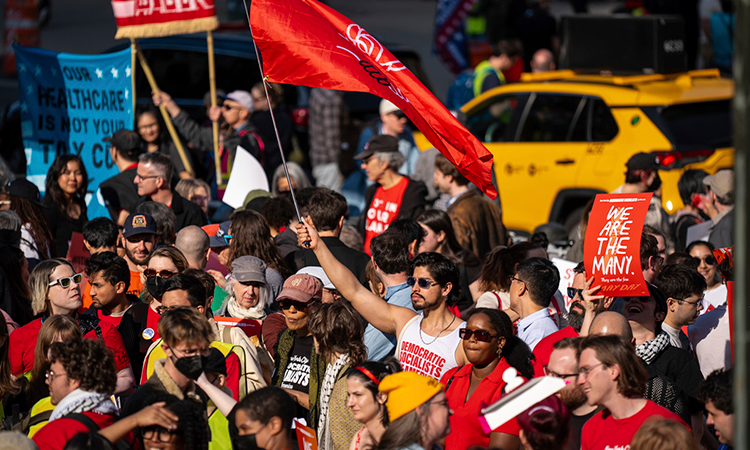
So, here we go. Four of the largest American cities have, or are about to have, open, avowed, loud & proud socialist mayors. Not long ago, those on the Left who harbored socialist predilections, like those who harbor indelicate sexual predilections, went to some trouble to hide them. (You’ll recall that the Grand Poobahs of the Democratic Party pushed Bernie Sanders off their presidential ticket in 2008 because he dared say the “S” word out loud.)
No longer.
In today’s ever-more-radical Democratic Party, being a socialist is a feature, not a bug.
Today, the leading lights of the Democratic Party are unapologetically socialist and the one-time “moderate” leaders of the party – think Pelosi and Schumer (and please note the air quotes around “moderate”) – increasingly find themselves on the outside looking in.
New York led the Dems’ leftward lurch in 2018 by electing Alexandria Ocasio-Cortez – a.k.a. AOC – to represent New York’s 14thCongressional District. But she now looks positively Churchillian compared to New York City’s new socialist mayor, Zohran Mamdani. Just this week, Democratic primary voters in New York nominated four more avowed socialists to represent the state in the U.S. Congress. There is little doubt that all four will win in the general election in November.
Moving across the country, Seattle mayor Katie Wilson is an avowed socialist. Los Angeles recently nominated avowed socialist Nithya Raman for mayor. She, too, is expected to win in the general.
The same for Washington, D.C.’s Janeese Lewis George, now the Democratic nominee for mayor, and also expected to easily win in November.
Those of us old enough to remember the Cold War and the collapse of the Soviet Union are shaking our heads in dismay as we realize that we’ve learned nothing from the failures of prior attempts at socialism. The lessons that followed from the Soviet Union’s collapse in 1991 apparently didn’t stick. Ditto the more recent story of Venezuela.
Socialism succeeds at little other than creating shared unhappiness. To the extent that China’s economy works, it’s because the 1978 reforms of Deng Xiaoping created a socialist/capitalist hybrid that made it possible – on a limited basis — for private citizens to own property (sort of) and accumulate personal wealth (sort of).
Socialists are misguided at best – believing that a small cabal of government “experts” can better direct the economy than millions of free individuals acting independently while risking their own capital.
They’re evil at worst because for socialism to work, it must steal the fruits of labor from the productive to give to the non-productive. That theft ultimately takes place at gunpoint.
But socialism’s dismal and bloody record notwithstanding, according to recent polls, as many as two thirds of Democrats now think it’s a good idea. They conveniently ignore socialism’s indisputable record of mass murder, mass misery and ultimate bankruptcy.
The lesson of 2026 is that the center of gravity in the Democratic Party is now socialist. We’re in uncharted waters. And I’d be a fool if I started predicting how it will all turn out.

So, we have a Memorandum of Understanding between the Trump administration and whomever it is that’s nominally running that broken, malfeasant, dishonest nation that we call Iran.
Already, the critics are weighing in. The usual suspects on the left are saying that Trump, after starting an “unnecessary war,” got nothing more than what Obama got from the JCPOA – a.k.a. the “Iran Deal” – back in 2015.
Here’s Senate Minority Leader Chuck Schumer:
After more than 100 days of bloodshed, 13 Americans killed, hundreds more wounded, tens of billions of dollars spent, what exactly did we get out of Trump’s failed war?”
Critics on the right are calling out Trump for not “finishing the job.” They argue, not unreasonably, that a purely diplomatic deal with Iran is impossible. An agreement signed on Monday will be violated early on Tuesday. Righty critics argue that only “boots on the ground” (how I detest that shopworn cliché) and a total military conquest of Iran can assure the world that Iran won’t resume its malfeasance at the first opportunity.
But there is exactly zero chance of “boots on the ground” (there it is again). Zip. Zilch. None.
With respect to Iran either not making or violating a deal, President Trump said this:
I let ‘em know, I said, look, if you don’t adhere to the agreement – I don’t want to do that – but we’re gonna bomb the hell out of you.”
Here’s how I’m calling it.
I said in this space last week that something had to give in Iran. I also recognize that the politics of the moment weigh heavily on the policy of the moment. If the Iranians have been “tapping us along” as we discussed last week, Trump may well be trying now to tap the Iranians along past the midterms. If he can, for the next 140 days or so, keep the Strait of Hormuz fully open and oil again flowing at market prices, it improves the (still long) odds of Republicans keeping control of Congress following the midterms.
As to Schumer and the rest of the critics on the left, what’s different from Obama’s JCPOA is that unlike what they thought about Obama, the Iranian theocrats know for certain that Donald Trump is a badass. They know that he will “bomb the hell out of them” if they don’t behave.
And unlike Obama’s deal, it’s not Obama making it. Nor is it Bush, Clinton, Bush or Biden – all of whom were willing at times to talk tough but never willing to act tough. And unlike the JCPOA in 2015, in 2026 Iran’s economy is on its knees while those now in charge there have fresh memories of how their predecessors died.
Will this deal work? Who knows? Time will tell. Critics from both sides may yet be proven right.
But something had to give, and something now has.
And for all the uncertainty, to an honest observer it’s undeniable that the U.S. is its best position vis. a. vis. Iran in nearly half a century.

A person sits in shallow water as cargo and commercial vessels are anchored in the Strait of Hormuz off Bandar Abbas, Iran, Monday, June 8, 2026. (Amirhosein Khorgooi/ISNA via AP)
Something has to give in Iran. I believe that it was President Trump himself who said we are being “tapped along” by whomever it is who is calling the shots in that beleaguered country.
Tapping the west along is a well-worn tactic for the criminal theocrats who run Iran. They have been doing it for nearly half a century. Tapping the Obama administration along got them an airlift of pallets of euros and Swiss francs to the tune of the equivalent of about $400 million courtesy of the United States Air Force. Part of that deal was that Iran would curtail its enrichment of uranium. They did no such thing.
So, we can’t be tapped along. This thing needs to come to an acceptable conclusion.
Iran wasn’t always the theocratically-controlled despotic hellhole that it is now. Throughout history Iran was known as Persia. It was only in 1935 that Reza Shah Pahlavi, then the country’s ruler (and the father of the Shah of Iran that we all remember from 1979), asked governments around the world to start calling the country Iran.
Unlike the dark, totalitarian misery that is today’s Iran, Persia was an enlightened, accomplished society. We can credit Persia with modern algebra and the word, “algorithm.” Ancient Persia was the home of astronomer, mathematician and poet Omar Khayyam (“A Jug of Wine, a Loaf of Bread – and Thou”).
Perhaps as much as any society, it was Persia that showed the world how to govern a large, diverse civilization through administration, infrastructure, tolerance, and cultural sophistication rather than through oppressive coercion.
All to say that the 90 million people who live in Iran today are the heirs of a rich, vibrant culture that has been suppressed by the theocratic thugs who took over the country in 1979.
President Trump is therefore reluctant to reduce the country to a pile of smoking rubble, though he can easily do so. Reducing Iran to the levels of devastation visited upon Europe in World War II would certainly neutralize the threat that Iran has posed to the civilized world for nearly 50 years. But it would simultaneously impoverish the Iranian people for a generation or more and perhaps create the circumstance for the rise of a regime that’s even worse than the one we have now.
But it may come to that whether we and President Trump like it or not. For the sake of the developed world on the macro level, and for the sake of our own domestic politics on the micro level, we must bring the business in Iran to an end.
The threat it has posed for nearly a half century must be decisively neutralized and the Strait of Hormuz must be open to the free passage of maritime commerce. Prior administrations going back to Jimmy Carter have been “tapped along” by Iran. But we can be tapped along no longer.
A decisive outcome in Iran may come at a horrendously painful price. But whatever the price, it must be paid.
And right soon.
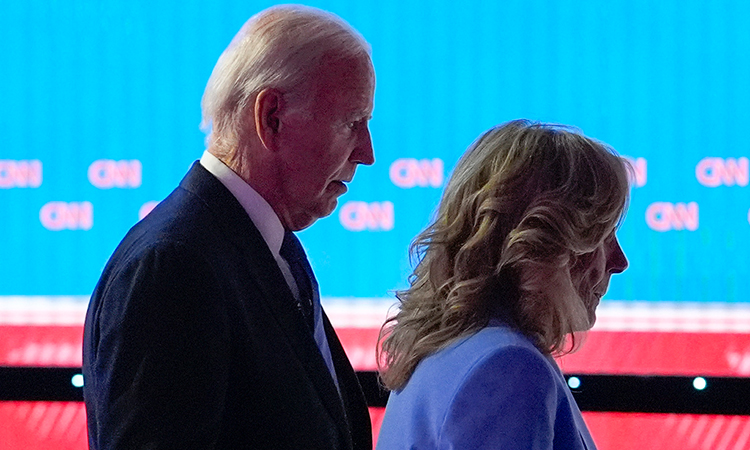
President Joe Biden, left, walks off stage with first lady Jill Biden, right, following the presidential debate with Republican presidential candidate former President Donald Trump, Thursday, June 27, 2024, in Atlanta. (AP Photo/Gerald Herbert)
Former First Lady Jill Biden is on TV and out on the interview circuit promoting her book titled, “View from the East Wing: A Memoir.”
In the book and in interviews, she tells us that she was just gobsmacked by her husband’s shocking performance during his debate with Donald Trump last June. We all remember it. It was that debate at the CNN Studios in Atlanta on June 27, 2024 that brought Joe Biden’s reelection bid, along with his nearly five-decade career in politics, to an ignominious end.
In a CBS Sunday Morning interview that aired this week the former First Lady said that she was afraid that her husband – the President of the United States – was having a stroke. She went on to say, “I had never, ever seen Joe like that before or since.”
I have questions.
First, if you truly feared that your spouse was having a stroke, would you just sit there? It has been drilled into us – time is the enemy on strokes. If Jill Biden thought her husband was having a stroke, she should have taken immediate action to get him medical attention.
But we all know she didn’t think he was having a stroke. She thought it was Thursday. That is to say, she had, “…seen Joe like that before,” because we had all seen Joe like that before. We had all seen the shaking hands with invisible people, and his inability to exit a stage, and the garbled sentences, and the vacant stare and the inability to complete a thought.
That sets up my second question. Will the country ever get to a tipping point on being lied to? The HBO mini-series “Chernobyl,” has a great line that I have appropriated. A Soviet nuclear scientist says at a state inquiry on the disaster:
Every lie we tell incurs a debt to the truth. Eventually, that debt comes due.”
When will that happen in our politics? Politicians have always “gilded the lily.” But today’s politicians – particularly Democrats protected by the media – lie with shocking boldness.
Will that rapidly increasing ‘debt to the truth’ ever reach critical mass after which a political tsunami ensues, washing the entire scurrilous lot of lying politicians and their lying apologists out of our lives? And will the legacy media ever stop enabling the lying and start realizing that their very continued existence depends on finding a way to regain the trust of the American heartland?
There’s no way that Jill Biden didn’t know that the president was a cognitive mess. Any of us who have ever had a relative sink into the abyss of dementia – and most of us have – knew exactly what we were seeing.
We could see that the President of the United States was mentally unfit.
But all that time the administration, the media and the lefty pundit class were in unison. ‘Sharp as a tack,” they said. ‘Outrunning us all.’
They were all lying then. Jill Biden is lying now.
And the debt to the truth remains unpaid – while interest accrues.
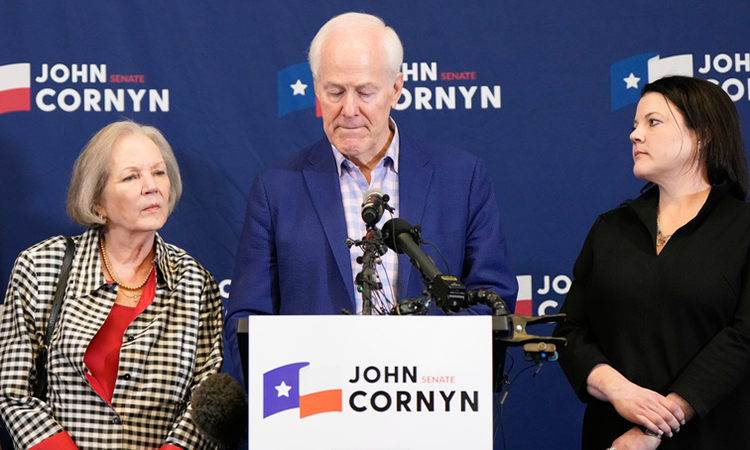
Sen. John Cornyn, R-Texas, center right, speaks alongside, from left, daughter Danley Cornyn, wife Sandy Cornyn and daughter Haley Cornyn, during a primary runoff election night event after losing the Republican party’s nomination Tuesday, May 26, 2026, in Austin. (AP Photo/Ashley Landis)
Texas Republicans have sent a clear signal. They want results.
In earlier times, the senior Republican senator from Texas could have held his seat for as long as he wanted. But John Cornyn, first elected to the Senate in 2002 after having garnered 77 percent in the Republican primary that year, just lost to Texas Attorney General Ken Paxton by a staggering 25 points.
Unthinkable as recently as 2020, when Cornyn enjoyed an approval rating of 62 percent according to a UT Tyler/Dallas Morning News poll.
And further hard to imagine considering that Ken Paxton has more personal and political baggage than an airport bag claim carousel. You can be certain that Democrats will do all they can to exploit that fact in the November general election against James Talarico, who is going to have a mountain of out of state, big donor cash supporting him and against whom victory by Ken Paxton is by no means certain. The attack ads against Paxton are going to be vicious.
I may be wrong but here’s my back of the envelope analysis. When the history of this election is eventually written, the fact that GOP senators failed to pass President Trump’s SAVE America Act – the bill that would require proof of citizenship and a government-issued ID in order to vote – may emerge as the decisive event that doomed John Cornyn’s reelection. The SAVE Act is a prime example of an 80/20 issue (as in 80 percent of voters in favor of passage) that Senate Republicans can’t seem to get done. (You’ll recall that they promised to repeal Obamacare if we would only vote them into the majority, which we did. Yet Obamacare lives on.)
Trump-supporting Republicans, now the majority of the party, have had it.
The SAVE Act failure was primarily because Senate Majority Leader John Thune, along with other Republican senators (but notably not John Cornyn), were unwilling to kill the filibuster so that the SAVE Act might pass on a simple majority vote.
I understand that reluctance. The filibuster has endured for as long as it has because both parties at one time appreciated its role in putting the brakes on heat-of-the-moment legislation.
But I also understand that if today’s far more radical Democrats ever retake control of the Senate, they will kill the filibuster about ten seconds after the swearing-in ceremony concludes. If that takeover ever happens to coincide with Democrats regaining control of the House of Representatives – and please note the thin GOP majorities in both chambers – statehood for Puerto Rico and the District of Columbia, accompanied by an expansion of the Supreme Court to 13 justices, will quickly follow.
One shudders.
John Cornyn was a largely very reliable vote for Trump’s agenda. But he suffers from being seen as an establishment Republican in a time when Republican voters are sick to here with the establishment standing in the way of getting the things voters want done.
That may not be fair to Cornyn. But no one ever said that politics is fair.
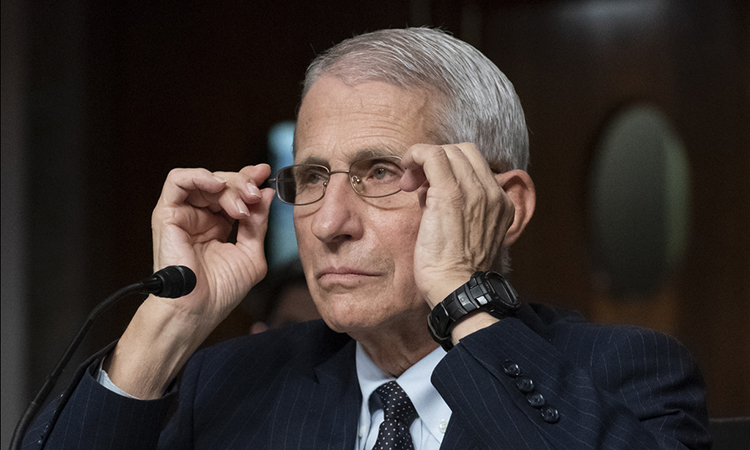
FILE – Dr. Anthony Fauci, director of the National Institute of Allergy and Infectious Diseases. (AP Photo/Alex Brandon, File)
On January 20, 2025 – just hours before President Joe Biden was to leave office – it was announced that he had issued a pre-emptive pardon to Dr. Anthony Fauci.
You remember Lord Fauci. He was the face of the COVID-19 pandemic. “I am the science,” he once said to an interviewer. In his role as head of the National Institute of Allergies and Infectious Diseases, he drove an entire nation into what amounted to house arrest.
To “stop the spread,” schools and churches were closed, the elderly died alone in nursing homes, uncomforted by family, small businesses were forced to close, and tens of millions of nominally free American citizens had to give up their livelihoods.
“Two weeks to flatten the curve” turned into two years of economic and social devastation. Small independent retailers and mom & pop restaurants were forced to shut down. They went out of business. But Target and Wal-Mart got to stay open. Their stock prices soared. Many of the former owners of the small businesses that were shut down now face their retirement years with little to get them by.
Young children who were kept from going to kindergarten and early elementary school are now teenagers and a huge percentage of them are behind academically and will likely never catch up.
Fauci had us maintaining six feet of social distancing while walking around with dirty masks on our faces in an affront to epidemiological science.
And it was his Lordship Anthony Fauci who convinced President Trump to fast track the development of mRNA vaccines in an effort that got dubbed “Operation Warp Speed.”
“Fine,” we all said.
But here’s what’s now coming to light that’s not fine.
For the drug makers to develop The Jab they demanded protection from product liability. Under the rules, to get that protection, the drugs would have to be deployed under an Emergency Use Authorization – EUA – from the Food & Drug Administration. But to get an EUA, there could be no other “approved, adequate and available” therapies.
The problem was that there was plenty of evidence that hydroxychloroquine (HCQ) and ivermectin – two readily available and inexpensive drugs with long use histories – were quite effective at treating COVID when administered early in the course of the disease.
The government spent more than $30 billion on The Jab. Drug makers Moderna, Pfizer and Johnson & Johnson, in turn, paid hundreds of millions in royalties to Fauci’s agency to license government-owned technology in their development. There are persistent but admittedly unproven rumors that Fauci profited personally from some of those payments. We’ll never know.
What we do know is that Fauci aggressively and often ruthlessly set out to crush any use of HCQ and ivermectin, their low risk and demonstrated effectiveness be damned.
What we’ll also never know is how many people died needlessly because Fauci quashed an inexpensive and low risk therapy in an apparent attempt to further his empire.
But what we always will know is that the Biden administration thought that he needed a pardon.
What do the following states have in common? California, Colorado, Illinois, Maryland, Massachusetts, Michigan, Minnesota, New Jersey, New York, Oregon and Pennsylvania.
There are three correct answers. First, they are all deep blue states that have been under the control of Democrats for decades (OK, Colorado went blue fairly recently). Second, they all run huge budget deficits. And third, they’re all in serious debt.
On average these states owe $18,800 for every citizen living in them. That per capita debt is rising every year.
To put that in perspective, the per capita in deep red Texas is only $4,500. In now even deeper red Florida, it’s a thousand dollars less.
Politicians in these blue states have figured out that they can buy today’s votes – and thus gain the power and perks of office – with tomorrow’s money. Tomorrow being when the sovereign debt that they incur for lavish, vote-buying social spending has to be repaid.
Since they won’t be in office when the bill comes due, it’s essentially free money.
It gets worse. The social programs funded by all this borrowing are almost always poorly managed and almost always fall far short of addressing whatever the problem was that led to their creation.
But wait, it gets worse still. Massive social programs are magnets for massive fraud. Here’s an example. Though the problem was known as far back as 2022, the story of staggering fraud surrounding an organization called, “Feeding Our Future” in Minnesota became national headline news in late 2025. Staggering is too weak an adjective. Mind bending might be better.
Feeding Our Future was what is called a “sponsor organization” whose purported purpose was to use government funding to provide meals to children living in poverty, particularly during the COVID-19 pandemic. But instead of feeding children, the organization submitted bills to the government to the tune of about $9 billion for meals that were never provided. The money went to Feeding Our Future principals who instead used it to buy luxury homes, commercial real estate, cars and jewelry. And, because the whole thing was run by Somali immigrants, a lot of the money also wound up being offshored to Somalia where it is credibly alleged to have funded terrorism.
Fallout from the Minnesota story became the catalyst for exposing similar fraud schemes in New York, Illinois and elsewhere.
The United States of America is $39 trillion in debt. That is a real problem and bad on its face.
But the debt burdens being carried by deep blue states could actually be worse. There is no mechanism in the Constitution or under federal law by which a state can declare bankruptcy. If a state can’t pay its sovereign debt, there’s no way to fix it.
And when more than 100 percent of a state’s tax revenue is soaked up by debt service, who do you guess will suffer first and suffer most?
If you guessed the poor who are dependent on the debt-funded government programs that politicians used to buy their votes, you guessed correctly.
Why is it that nominally well-educated people can’t look at a set of observable facts and come to a logical conclusion? Observable facts are all around us. Yet logical conclusions remain elusive.
A clear example of observable facts can be seen in the influx of Californians moving to Texas. By the thousands lifelong citizens of the Golden State are coming to the Lone Star State. If you doubt me, drive around Dallas, and look at the volume of high-rise residential construction – both condos and apartments.
People from California aren’t coming to Texas for the pleasant summertime weather. They’re coming because of the massive dysfunction of California brought about by decades of leftist policy.
I’m bringing up California because the governor’s race in that state is in the news. Because of the unusual way that California conducts its primary elections – and I won’t spend the time to explain it here – a Republican has a plausible shot at becoming the next governor, replacing far-left pretty boy Gavin Newsom. (Newsom, for his part, wants to be the Democrats’ nominee for president in 2028.)
California, once the most beautiful, most prosperous, and most envied state in the Union, is a hot mess. Taxes in California are among the highest in the nation, yet the state’s roads are crumbling, its schools are failing, its big cities are degenerating, the state is essentially insolvent, the middle class is heading for the exits and an astonishing number of those left behind are living on the streets.
Astonishing indeed. California is the homeless capital of the nation. Nearly a quarter of all the homeless people in the entire country live there. Compare to Texas, the next most populous state, where fewer than four percent of the nation’s homeless live.
And as much as Democrats will try to make it so, none of this is Donald Trump’s fault. Trump has held one elective office two times for a combined total of just over five years. The last time that Republicans had a majority in the California legislature was 1970. The last Republican governor was Arnold Schwarzenegger, who left office in 2011 (and barely counts as a Republican anyway).
Decades of Democrat policies have brought once great California to the brink and yet no Democrat and no one in the leftist dominated media ever connects the dots.
When Lyndon Johnson began promoting his liberal Great Society programs in the mid 1960s, the debate was largely abstract. Big-government welfare at such scale had never been tried before.
But 60 years later we have hard data. The Great Society was a failure. The poverty rate of 2026 is little changed from the poverty rate of 1966. Yet poverty today is, perversely, even more deeply entrenched than it was when the Great Society launched.
Six decades of experience now shows that liberal, big-government programs not only don’t solve problems, they most often make the problems they set out to solve worse.
California – once the wealthiest, most envied state in the Union – is the clearest possible illustration.
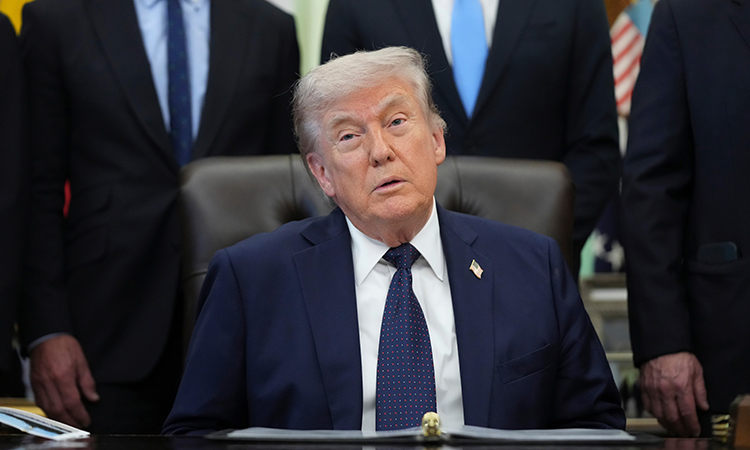
President Donald Trump speaks during an event on health care affordability in the Oval Office at the White House, Thursday, April 23, 2026, in Washington. (AP Photo/Mark Schiefelbein)
Donald Trump is a polarizing figure. (In other news, it gets hot in Texas in the summer.)
More than any recent president, Donald Trump evokes a visceral reaction among a large proportion of voters. Millions of people – disproportionately concentrated in coastal states – despise the man.
A big reason is his outsized, brash personality that is unlike that of any politician in our time. Since the 2015 escalator ride that kicked off his first campaign, we have observed his penchant for incendiary statements, insulting personal attacks and often outlandish exaggeration. To a significant degree, Donald Trump himself has contributed to much of the animus against him. (To be fair, many of these characteristics have been greatly muted in his second term.)
But for my money, one of the biggest and most consistent contributors to Trump hatred is the corrupt and fundamentally dishonest legacy media. Shrinking in size, scope and influence as the legacy media are, a meaningful percentage of Americans still rely solely on the likes of ABC, CBS, NBC, et. al. for their news. In the same way that the diet of a college kid is carb heavy, the news diet of a legacy media consumer is agenda heavy. Members of the legacy media almost to a person see it as their civic and sacred duty not to merely report on what Donald Trump does and allow readers and viewers to form their own conclusions. They see themselves instead as specially charged with saving the republic from him. Example: If Trump vigorously prosecutes attacks on Iran, the media says he’s a “war criminal.” If he extends a ceasefire, they say he’s a “TACO” (i.e. Trump Always Chickens Out.)
The once-trusted legacy media are using the last shards of the credibility they once enjoyed to intentionally and shamelessly lie about Trump, his policies and his accomplishments.
And there’s a key word: accomplishments. They are many.
Since taking office for his second term, Trump has essentially stopped illegal immigration. Not slowed it down. Stopped it. It’s a campaign promise kept.
Another campaign promise: energy independence. The president has unleashed the American oil & gas industry in way that is completely reshaping the world geopolitical landscape for the long term in America’s favor. (It’s worth noting that in times not so long past, a war in Iran and the closing of the Strait of Hormuz wouldn’t have simply caused gas prices to go up, as has happened. There would have been gasoline lines.)
Some agenda-laden reporting to the contrary notwithstanding, very soon Trump will have completed the neutralization of a terroristic, nuclear weapons-seeking Iran – a regime that vexed seven prior administrations while holding the entire world hostage.
All of this while lowering the tax burden on every single American taxpayer.
There’s more, but space doesn’t permit.
The real knock on Trump boils down to this. The man has had the temerity to actually take on and solve problems that establishment politicians – of both parties – merely fundraise on.
In the realm of high-level Washington politics, that’s simply unforgivable.
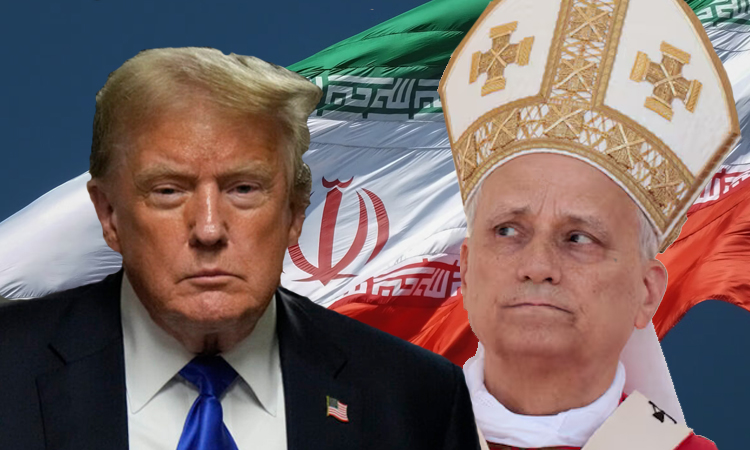
President Trump and Pope Leo XIV are in a war of words over the war in Iran. It’s the most open dispute between an American president and a Roman pontiff that anyone can remember.
Without calling him by name, the pope has been sharply critical of Trump. While on a visit to Cameroon the pope spoke of a world, “ravaged by a handful of tyrants.” The statement is widely believed to be specifically referencing the president.
In a social media post, the pope said, “God does not bless any conflict.” Immediately following the beginning of hostilities on February 28, the pope said that peace comes, “…not through weapons but through dialogue.”
For his part the president has specifically named the pope in his responses. In trademark fashion, he has pushed back hard on the pontiff, saying in a Truth Social post, “Pope LEO is WEAK on crime and terrible for Foreign Policy.”
The pope’s defenders – which includes what is likely a majority of U.S. Catholic bishops – are saying that Pope Leo’s criticism of the Iran war is nothing more or less than the sum of Catholic teaching about war.
I believe that position deserves closer examination.
Such examination begins with the stipulation that a Roman pontiff is going to condemn war. That should surprise no one. But such condemnation then begs the question, “Where has Pope Leo so outspokenly condemned the known atrocities of the Iranian regime?” Oh, he frequently calls for respect for human dignity and fundamental human rights; i.e. papal boilerplate – the rhetoric of every pope.
But if Leo has as pointedly called out Iran as he has the United States and Donald Trump, I can’t find it (and neither can ChatGPT, because I asked when I could find nothing on my own).
As to the pope’s condemnation being consistent with Catholic teaching regarding war, let’s examine the writings of revered Catholic theologian and priest, St. Thomas Aquinas. In his late 13th century opus Summa Theologica, Thomas says that war is justified when it is waged by a sovereign nation in defense of a common good and when the good intended outweighs the evil of war.
With respect to the war in Iran, I’d say check, check and check.
The U.S. is preventing nuclear weapons from coming into the hands of a nation that is openly relentless in its pursuit of having them. Preventing a regime like that of Iran, with its clear and undisputed record of terrorism, mass murder and evil, is to my eye, a rather straightforward exercise in the defense of a common good.
As to peace coming via dialogue rather than weapons, the president tried that. It went nowhere. U.S./Iranian dialogue accomplished nothing other than to provide the forum for Iran to proudly and unapologetically boast of its possession of about a thousand pounds of uranium that could be enriched to weapons grade in less than two weeks.
And finally, there’s this.
Dialogue did not save the world from the evils of Adolf Hitler. That effort required weapons.

At RealClearPolitics.com on Thursday, Ben Shapiro made a brilliant point. It’s one you won’t see made anywhere in the “mainstream media.” (Will someone please explain to me why we keep using that term?)
FROM THE ARCHIVES: “How are these people “mainstream?”
In his article, Shapiro observes that in the same week the United States has waged war in Iran with precision, technological prowess and profound impact in a way that, as he says, “…looks like something written for a Hollywood script;” while also sending human beings into space farther from Earth than ever in the 65-year history of human spaceflight (which, as it happens, we will mark on Sunday, April 12).
In both cases, the United States made it look easy. In both cases, it’s anything but.
This, says Shapiro, is what a superpower looks like. He’s right.
On the Iran war front, the United States has clearly demonstrated a capacity to deliver offensive force with surgical precision and devastating consequence. We have shown that enemy forces and their malign leaders can be precisely tracked and eliminated. In this conflict, Iran had at its disposal air defense systems provided by Russia and China that are the very best non-U.S. defense systems in the world. Yet they proved nearly worthless when put to the test against the forces of the United States.
Such capability facilitates maximum military advantage with minimum impact on civilian lives. Don’t think that Putin and Xi haven’t noticed. They have.
America’s current military capability again illustrates something I have said for decades.
No nation in history has ever amassed more power and yet been so restrained in its use.
The United States if it chose to do so could dominate the world. That is precisely what powerful nation states have done for most of human history. But not so this country.
In its 250-year history, for all its admitted faults, imperfections and missteps, the United States to an astonishing degree has eschewed empire and conquest and has instead limited its use of its military power to the defense of peace.
And that bring us to the Artemis II circumlunar mission – the first manned lunar mission since Apollo 17 in December 1972. As I write this, the spacecraft with its four astronauts is on its way to a Pacific Ocean splashdown a little after seven o’clock Friday evening Texas time. Assuming a safe splashdown, the mission has been a massive success. The Orion spacecraft has been very nearly flawless. (The only real anomaly was in connection with the on-board toilet.)
In the 1960s, the race to the moon was between the United States, a nation rooted in individual liberty, and the Soviet Union, a nation rooted in authoritarianism and oppression. The U.S. won that race and the Soviet Union eventually collapsed. National prestige can shape a nation’s destiny.
Today, China replaces the Soviets in what is essentially the same contest. National prestige is again on the line and again plays the same role.
So, with all that in mind, Ben Shapiro is right. America has had a good week.

I remember Christmas Eve 1968 like no other Christmas Eve in my life. I was a young boy at the time. Apollo 8, the first ever manned space mission to leave Earth orbit, was orbiting the moon.
The world was following the story, and more than a billion people worldwide were watching that Christmas Eve as the crew conducted a live telecast from the Apollo command module.
As the telecast was concluding, astronauts Frank Borman, Jim Lovell and Bill Anders stunned the world when they began reading from the first chapter of the Book of Genesis. Aside from Borman, Lovell and Anders themselves, no one knew it was coming. Not NASA management. Not the flight controllers in the Mission Operations Control Room. It was a complete surprise.
And it had seismic impact.
That telling of the creation story – by men who were experiencing a perspective on creation in a way like no human in all of history – was riveting. And in that moment – the end of the awful year 1968 in which the Vietnam War raged, riots plagued major American cities and Martin Luther King, Jr. and Robert F. Kennedy were both assassinated – was somehow yet redeemed.
As the story goes, when the crew returned home to Houston, mission commander Frank Borman received a telegram from an anonymous sender saying simply, “Thank you. You saved 1968.”
Fifty-eight years later, and for the first time since December 1972, a manned American mission is again on its way to the moon on a mission profile remarkably similar to that of Apollo 8. Apollo 8 flew 10 orbits around the moon to test the spacecraft in deep space and to validate navigation, crew systems and reentry and recovery procedures – all with an eye toward a future lunar landing mission.
Three American astronauts and one Canadian astronaut are aboard the Artemis II mission in a spacecraft that borrows heavily from the Apollo flight hardware and their mission objectives are nearly identical. The only real difference is that Artemis will slingshot around the moon and immediately head back home, rather than decelerating into lunar orbit.
Though a creation story moment is unlikely on this mission, I nevertheless hope that a successful mission might restore some pride in American accomplishment. Great nations dare to do great things purely for greatness’s sake.
In the 1960s, the world was watching the United States and the Soviet Union – two nations with diametrically opposed views regarding individual and economic freedom – to see which of the two could muster the political, scientific and engineering resources necessary to lead the way in space.
Six decades later, the contest is between the United States and China. And again, the world is watching to see which nation will emerge as the leader.
It mattered then. It matters now. A nation’s prestige has a great deal to do with its ability to shape world events.
Apollo 8 had its detractors, and this mission does, too.
But most of us “got it.” I pray that we “get it” again.